

Red Monastery Sohag Egypt: Coptic Art, Wall Paintings & Travel Guide
Galería
Introduction
The Red Monastery Sohag is one of the most important monuments of Christian Egypt and one of the most visually astonishing religious sites in the Nile Valley. Known in Arabic as Deir al-Ahmar Sohag, the site is a major Red Monastery Coptic monastery and a powerful example of early Christian monastery Egypt heritage. ARCE describes it as one of Byzantine Egypt’s most glorious painted sanctuaries, while Smarthistory calls the church an unparalleled example of a brightly painted “jeweled style” interior.
If you are asking what is the Red Monastery, the best answer is this: it is a historic monastery near Sohag whose principal church preserves one of the most remarkable surviving ensembles of Red Monastery wall paintings, Red Monastery frescoes, and sacred decoration in Egypt. Official Egyptian monument sources note the church’s eastern end terminates in a tripartite structure decorated with tempera murals showing biblical scenes, Christ, the Virgin Mary, the Four Gospels, and the Apostles.
For modern travelers, Red Monastery Egypt is much more than a local church. It is a major Red Monastery attraction, a center of Christian heritage Sohag, and one of the strongest reasons to include Sohag on a cultural itinerary through Upper Egypt. The World Monuments Fund highlights the Red and White Monasteries together as among the best-preserved historic churches in Egypt.
📊 Quick Overview Table
| Topic | Answer |
|---|---|
| Main name | Red Monastery Sohag / Deir al-Ahmar Sohag |
| Religious identity | Red Monastery Coptic monastery |
| Main dedication | Often identified with Saint Pishoy / Bishai in Sohag tradition |
| Best known for | Red Monastery wall paintings, frescoes, painted apse |
| Period | Late Antique / early Christian Egypt, mainly 5th century church fabric |
| Architectural type | Red Monastery triconch church |
| Strong travel angle | White and Red Monasteries Sohag day visit |
This table gives the fastest answer to Red Monastery explained, Red Monastery facts, and why is the Red Monastery important.
🏺 What Is the Red Monastery?
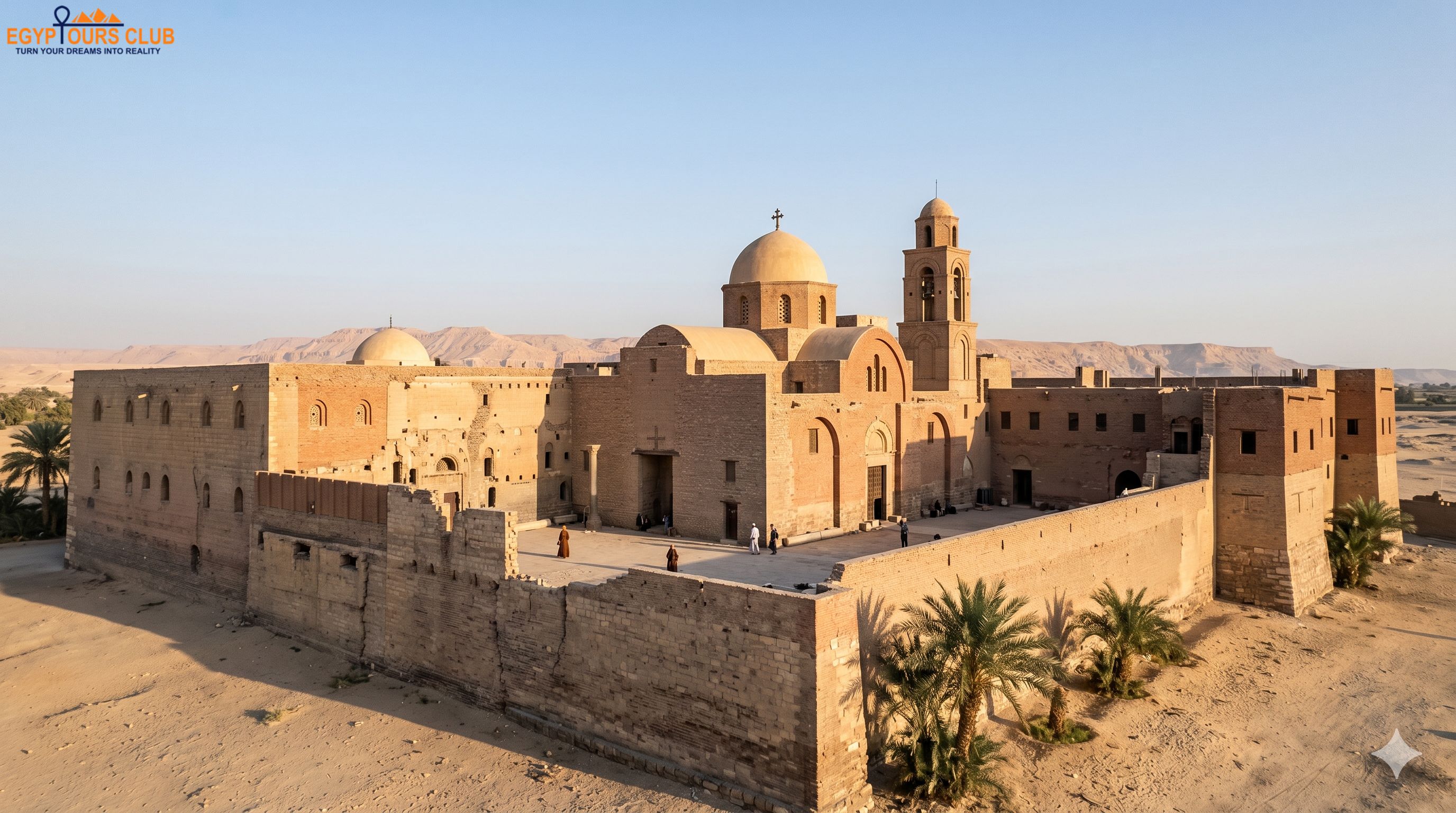
The Red Monastery church Egypt is a major Coptic monastic site near Sohag in Upper Egypt. It is often associated with Saint Pishoy in local and ecclesiastical tradition, which is why searches such as Monastery of Saint Pishoy Sohag and Saint Pishoy monastery Sohag appear alongside the main site name. Egypt’s official monuments portal describes the church as a long rectangular space with three wings, the central one being the largest, and ending in a tripartite sanctuary richly decorated with mural paintings.
The name “Red Monastery” comes from the red fired brick used in the monastery’s outer construction, which distinguishes it from its nearby counterpart, the White Monastery. This physical contrast is one reason why the pairing White and Red Monasteries Sohag has such strong travel and heritage value.
So if a reader wants Red Monastery explained in one sentence, here it is: the Red Monastery is a historic Coptic monastery in Sohag whose church preserves one of the richest painted interiors of Late Antique church Egypt.
🧱 History of the Red Monastery Sohag
The history of the Red Monastery Sohag reaches back to the early centuries of Christian Egypt. The principal church is generally dated to around the late fifth century, with later additions and continued use. Smarthistory dates the Red Monastery at Sohag to around 500 CE, while the monastery tradition itself is linked to a saint called Pishay or Psoi.
This makes the site a major example of early monasticism Egypt and a key monument for understanding early Christian monastery Egypt history. The World Monuments Fund and ARCE both emphasize its importance not only as a monastic foundation but also as a unique survival of architectural and pictorial heritage from late antiquity in Egypt.
Because of that long and layered history, the Red Monastery is not only important to Coptic tradition. It is also crucial for the study of Coptic architecture Upper Egypt, wall painting, and the development of Christian sacred space in the Nile Valley.
🎨 Why Is the Red Monastery Important?
The main answer to why is the Red Monastery important lies in art. ARCE notes that for decades visitors saw only darkened remains, but restoration revealed bright and extraordinary painted decoration once again. Smarthistory describes the church as an unparalleled example of a brightly painted interior, and the AAE portal calls it the most important surviving early Christian monument in Egypt’s Nile Valley.
This is why keywords like:
- Red Monastery wall paintings
- Red Monastery church paintings
- Red Monastery frescoes
- Coptic murals Egypt Sohag
- painted church in Egypt
are central to the page. The Red Monastery is not famous because it is merely old. It is famous because it preserves rare monumental painting at a level almost unmatched in Egypt.
For heritage travelers, this makes the site far more than a local monastery. It becomes one of the strongest destinations for anyone interested in Coptic art Sohag, Christian heritage Sohag, or the visual culture of Egyptian Christianity.
🖼️ Red Monastery Wall Paintings, Frescoes, and Church Interior
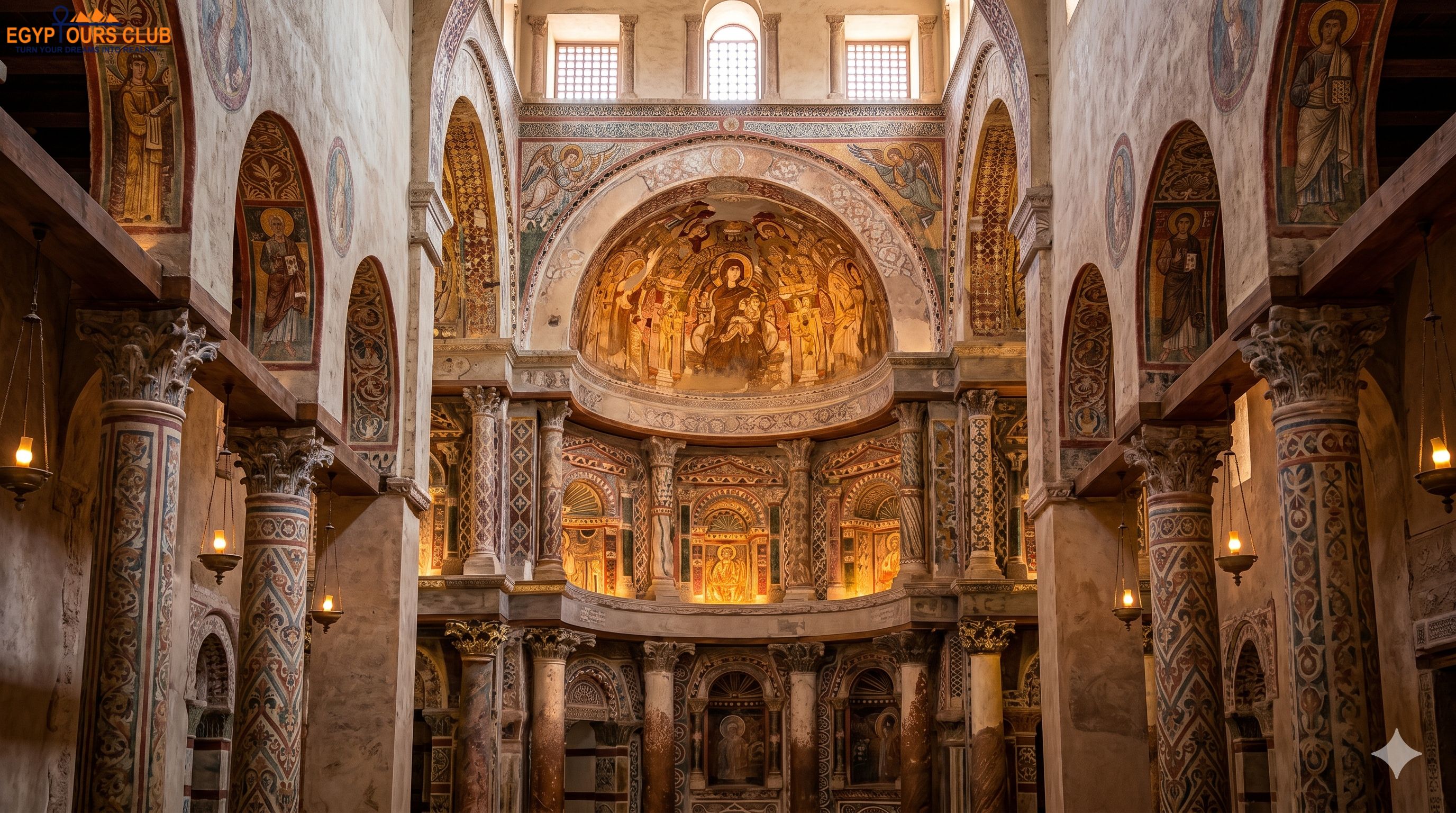
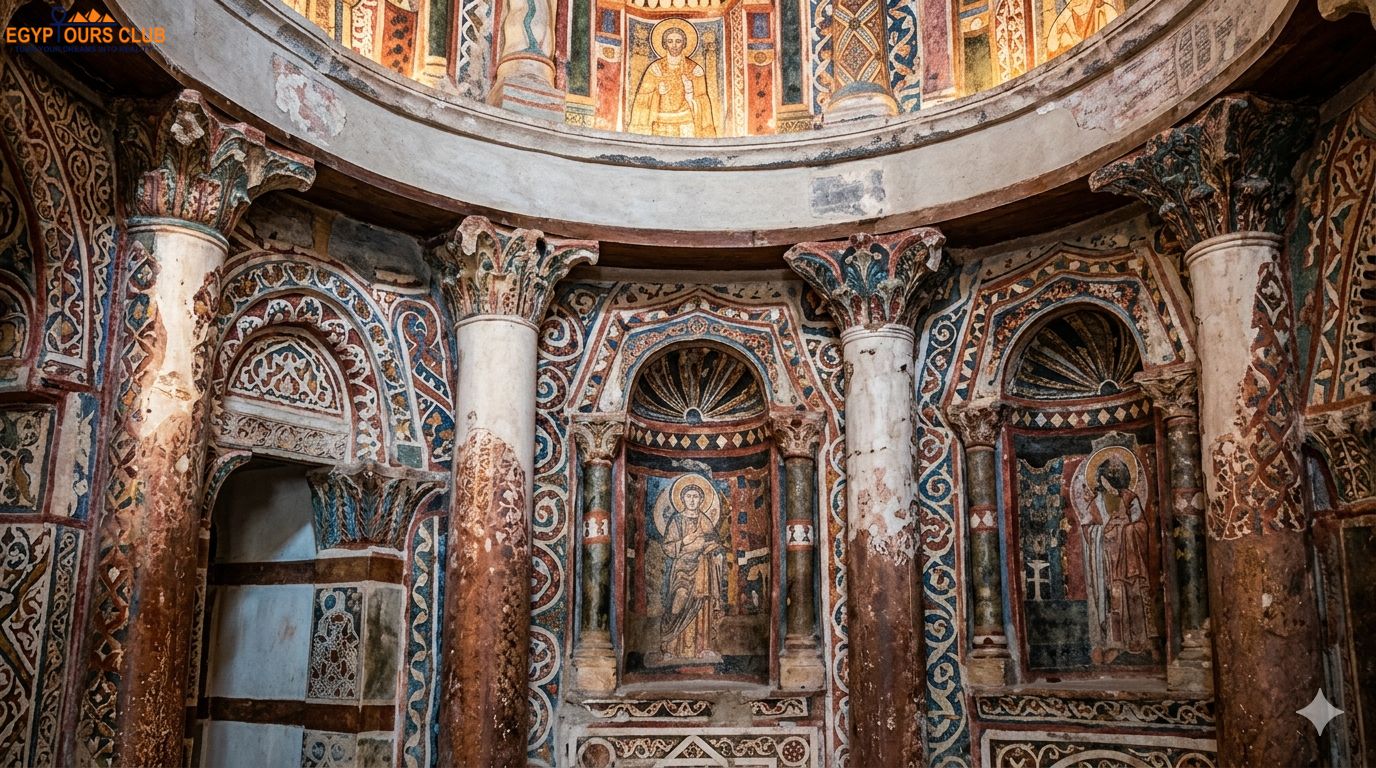
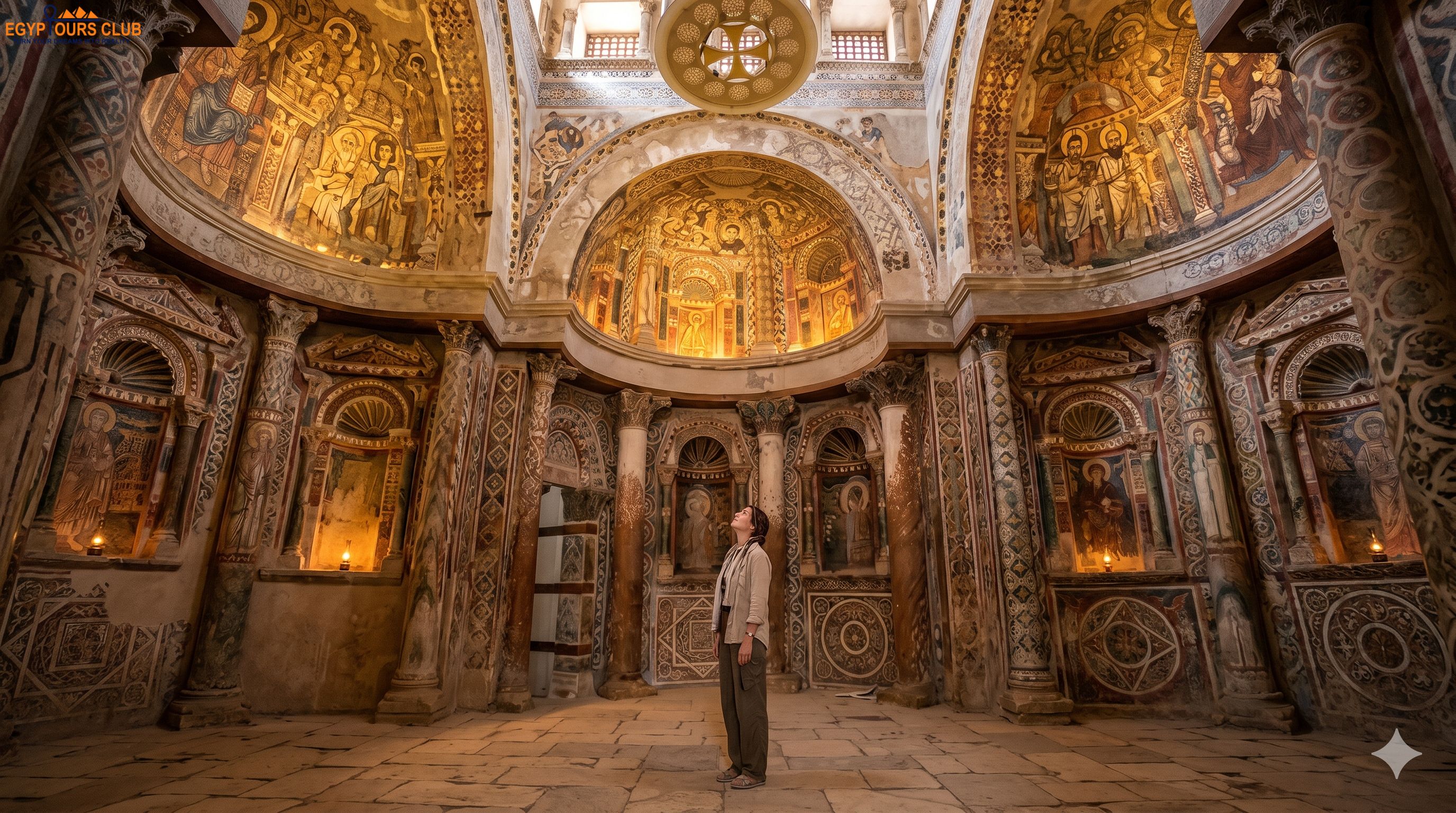
The strongest visual identity of the site lies in the Red Monastery interior. The sanctuary and apse preserve a rich decorative program with painted niches, saints, biblical figures, ornamental bands, and layers of color that give the church its now-famous jewel-like appearance. ARCE’s conservation work focused on these wall paintings, while Egypt’s official monuments page emphasizes the tempera-painted biblical murals of the church’s eastern end.
This is why so many high-value visual keywords belong here:
- Red Monastery photos
- Red Monastery wall art
- Red Monastery painted apse
- Red Monastery church interior
- Red Monastery fresco image
These are not just SEO phrases. They reflect the actual experience of the site, where the painted sanctuary is the emotional and artistic climax of the visit.
The effect is especially powerful because the architecture and painting survive together. Instead of disconnected fragments, the visitor experiences a sacred interior where structure, color, and theology still work as one.

🏛️ The Red Monastery Triconch Church
One of the most architecturally important aspects of the site is the Red Monastery triconch church. Egypt’s official monuments site identifies the eastern end as a tripartite structure, while scholarship on the church discusses the triconch sanctuary as a defining feature. The sanctuary’s three apses, layered niches, painted columns, and decorative systems create one of the richest surviving sacred interiors in Egypt.
This matters because the church is not only an art monument. It is also a masterpiece of Coptic architecture Upper Egypt. The columns, sanctuary articulation, and apse program make Red Monastery columns and overall architectural analysis important content angles in their own right.
For readers interested in church history, the Red Monastery offers a rare chance to see how Late Antique church Egypt could combine monastic restraint with extraordinary visual richness.
✝️ Red Monastery and Early Christian Monasticism in Egypt
The Red Monastery must also be understood through the lens of early monasticism Egypt. Upper Egypt played a central role in the history of Christian monasticism, and Sohag was one of its major landscapes. The White and Red Monasteries belonged to an important monastic network in the region, and Yale’s work on the White Monastery notes that it was the primary member of a federation that also included the Red Monastery.
This broader setting makes the Red Monastery more than an isolated church. It was part of a living world of monastic prayer, discipline, pilgrimage, liturgy, and artistic expression. That is why keywords like early Christian monastery Egypt, Christian heritage Sohag, and religious history in Upper Egypt all fit naturally into the page.
⚪ White and Red Monasteries Sohag
One of the best travel and SEO angles is the pairing White and Red Monasteries Sohag. The two monasteries are close to each other and are often visited together, making White Monastery and Red Monastery one of the strongest content clusters in Sohag. The World Monuments Fund treats them as a linked heritage pair, and travel writing on the region often presents them as a combined destination.
This pairing is excellent for users searching:
- White and Red Monasteries tour
- Sohag monastery tour
- things to do in Sohag Egypt
It also helps the Red Monastery page rank not only as a standalone attraction but as part of a broader Upper Egyptian Christian heritage route.

📸 Red Monastery Photos, Interior, and Visual Appeal
For many readers, the strongest entry point into the site is visual. Searches such as Red Monastery photos, Red Monastery interior, Red Monastery wall art, and Coptic murals Egypt Sohag reflect the fact that the site is instantly memorable once seen. ARCE restoration material and Smarthistory’s discussion both highlight the extraordinary effect of the restored interior.
Unlike many monuments where surface damage dominates the experience, the Red Monastery gives visitors a vivid sense of how painted sacred architecture once looked. This is one reason the church has become increasingly important for art historians, conservators, and travelers interested in Christianity in Egypt.
In practical SEO terms, the visual strength of the site supports image search, travel content, and long-form heritage pages in a way that many lesser-known destinations cannot match.
🚐 Red Monastery Tour and Travel Value
From a travel perspective, Red Monastery tour and Sohag monastery tour are strong intent keywords because the site fits naturally into cultural itineraries through Upper Egypt. It is especially valuable for travelers who want something beyond the classic pharaonic circuit and are interested in Christian Egypt, monastic history, sacred art, or lesser-known heritage destinations.
The site works especially well for:
- travelers exploring things to do in Sohag Egypt
- visitors interested in White and Red Monasteries tour
- readers looking for hidden Christian heritage in Egypt
- specialists in art, monasticism, or late antique history
This gives the page strong dual intent: educational authority and travel utility.

✅ Final Answer
So, what is the Red Monastery?
The Red Monastery Sohag Egypt is one of the most important surviving Coptic monastery in Sohag sites and one of the finest examples of a painted church in Egypt. It is famous for its restored wall paintings, rich late antique interior, triconch sanctuary, and its place within the wider monastic heritage of Sohag alongside the White Monastery.
If you want the shortest summary:
The Red Monastery is a major Coptic monastery in Sohag whose brilliantly painted church preserves one of the greatest surviving monuments of early Christian art in Egypt.
FAQ
What is the Red Monastery?
The Red Monastery is a historic Coptic monastery near Sohag in Upper Egypt, best known for its painted church interior and late antique wall paintings.
Why is the Red Monastery important?
It is important because it preserves one of the most remarkable surviving ensembles of early Christian painting and architecture in Egypt.
Why is it called the Red Monastery?
It is called the Red Monastery because its outer walls were built of red fired brick, distinguishing it from the nearby White Monastery.
What can you see inside the Red Monastery?
Visitors can see vivid wall paintings, a painted apse, decorated columns, and a remarkable triconch sanctuary.
Is the Red Monastery a Coptic monastery?
Yes. It is one of the major surviving monuments of Coptic Christian monastic heritage in Upper Egypt.
Can you visit the Red Monastery with the White Monastery?
Yes. The two sites are often paired as White and Red Monasteries Sohag and are among the strongest heritage destinations in the region.
Why is the Red Monastery famous for art?
It is famous for its restored wall paintings and brightly decorated sanctuary, which make it one of the most important painted churches in Egypt.